

Then after 1798—as economic historians have discovered over the past few decades—life in quite a few places got better. Slowly, and then quickly, and by now with unstoppable, ramifying, worldwide force, it got much better. Material life got better not merely for Europeans or imperial powers or Mr. Moneybags, but for ordinary people from Brooklyn to Beijing.
The betterment stands in human history as that Great Enrichment, the most important secular event since we first domesticated squash and chickens and wheat and horses. The Enrichment has been and will continue to be more important historically than the rise and fall of empires or the class struggle in all hitherto existing societies. Such perennial fascinations of historians, entranced by the realpolitik that accompanies empires rising and classes struggling, had little to do with our enrichment. Empire did not enrich Britain. America’s success did not depend on slavery. Power did not lead to plenty, and exploitation was not plenty’s engine.
The real engine was the expanding ideology of liberty and dignity that inspired the proliferating schemes of betterment by and for the common people. Liberty and dignity for ordinary projectors yielded the Bourgeois Deal: “You accord to me, a bourgeois projector, the liberty and dignity to try out my schemes in voluntary trade, and let me keep the profits, if I get any, in the first act—though I accept, reluctantly, that others will compete with me in the second act. In exchange, in the third act of a new, positive-sum drama, the bourgeois betterment provided by me (and by those pesky, low-quality, price-spoiling competitors) will make you all rich.” And it did.
The ideology supporting the Bourgeois Deal displaced that of the Aristocratic Deal: “You honor me, an aristocrat by natural inequality, and give me the liberty to extract rents from you in the first act, and in the second and in all subsequent acts. I forbid you under penalty of death to seek competitive ‘protection.’ By the third act of the zero-sum drama, if you have behaved yourself, and have pulled your forelock or made your curtsey as I ride by, I will not at least have slaughtered you.” It was extortion, not protection. As an economic historian put it, reacting in 1971 to the claim by an economic theorist that feudal lords had offered “protection” to peasants, “The possibility that the main, if not the only, danger against which the peasant very frequently was in need of protection was the very lord is not mentioned.”[1]
The bourgeois, voluntary, egalitarian, bettering ideology writ across a society is recent, and therefore cannot be put down to ancient risings of empires and strugglings of classes, or to biological evolution on a scale of centuries. We did not become rich at the time of the rise of trade, which is paleolithically ancient, or upon the establishment of towns and the agricultural state and the legal protection of real property, which are less ancient but nonetheless many millennia old, or in long times of peace, which has characterized life in economically stagnant places as much as in Europe 1815–1914. An ideological change did it, and recently. In northwestern Europe the strange idea grew up that aristocracy (the rule of the best by descent) and theocracy (the rule of priests) and even plutocracy (the rule of the present rich) were all nasty. What replaced them in people’s ideology, slowly, was the rule of the better technique, allowing free entry to compete with the monopolies that the aristocrats or the plutocrats had arranged under the aegis of a captured government. The new ideology in places like Britain and Belgium around 1800 favored a “betterocracy,” or, if you want the pure Greek, a “kaluterocracy.”
The profit going to the betterers was promptly undermined, unless governmental monopolies and governmental protectionism intervened. The economist William Nordhaus has calculated that betterers nowadays earn in profit only 2 or 3 percent of the social value of their inventions.[2] If you are Sam Walton bettering the retail trade in the matters of inventory control and purchasing contracts, the 2 percent yields a great deal of money. But 98 percent at the cost of 2 percent is nonetheless a pretty good deal for the rest of us. The gain from macadamized roads or vulcanized rubber, then modern universities, structural concrete, and detergent, and then the airplane and the transistor, enriched even the poorest among us.
The new ideology of kaluterocracy spread quickly. In modern conditions of communication (invented by the bourgeoisie, with helpful inputs from secret police eager to read their gentlemen’s mail), quickness rules. As Gaus put it, summarizing the work since 1985 by Peter J. Richerson and Robert Boyd and other proponents of group-level evolution (which was until the 1980s considered rank scientific heresy), “Group-beneficial norms can spread much more quickly within a group via copying or imitation; major cultural changes can occur within 200 years (or indeed considerably less).”[3] And they did, starting in Holland in the sixteenth century and spreading to England in the eighteenth, and now, two hundred years on, spreading to China and India.
For example, the lower end of the world’s present income distribution, the bottom billion out of seven, as Ó Gráda has documented, has seen a dramatic decline of famine.[4] In the European Middle Ages a killing famine in the favored south of England came every ten years or so.[5] The last widespread, killing famine in southern England was 1597, in northern England 1623, in Scotland the 1690s, in France 1710, in Germany, Scandinavia, and Switzerland 1770–1772, in Ireland the late 1840s, in Finland 1866–1868.[6]
The upper middle of the present-day seven billion—perhaps two billion, double the population of the world in 1800—live in countries in the mold of Greece or Taiwan or Israel. The average income of such places exceeds $80 a day, which is to say two and a half times the present world average, and twenty-six times the world average in 1800. Hans Rosling, a Swedish professor of public health, calls $80 “the Washing Line,” because at that level a household can have an electric washing machine, freeing women from exhausting wash days.[7] Deborah Fallows reports on a study of material aspirations among the upper bourgeoisie in China: “In the 1950s and 1960s . . . a watch, a bicycle, and a sewing machine. In the 1970s and 1980s . . . a color television, a fridge, and a washing machine. . . . By the late 1990s . . . foreign holidays, . . . computers and cars, and [the wherewithal] to buy their own houses.”[8] In 1943 in Lansing, Michigan, my mother, a young middle-class woman, would wash the family’s clothing by hand down in the basement, using tubs with washboards. My grandfather, an electrical contractor, was dismayed and bought her a small electric washing machine. One of Donna Leon’s mystery novels set in Venice portrays chief inspector Guido Brunetti in 2012 noting to the department secretary, Signorina Elettra, that people in olden days were miserable: “They’d probably give you anything you asked for,” he declares, “in exchange for a washing machine.” Signorina Elettra laughs in agreement: “I’d give you anything. . . . I suspect that most people—at least the women—would willingly renounce their right to vote in exchange for a washing machine.”[9]
And the higher, electric-drying end of present-day incomes, over $120 a day, enjoyed now by about half a billion people worldwide, a group growing rapidly each year in number and in share of the world population, and set to become in a few generations the typical human, supports a flourishing life of loft apartments, art museums, higher education, adventure holidays, spiritual exercises, Donna Leon mystery novels, and all the ennobling and not-so-ennobling goods and services of a modern bourgeois town.
§
In other words, when we economic historians lecture to undergraduates we emphasize an anti-Malthusian message of hope—that average human welfare has shot up startlingly since 1800. A graph of average income over time resembles an ice-hockey stick, with tens of thousands of years spent tracing the long, horizontal handle. Then finally, after 1800, history reached the business end of the hockey stick and shot up the blade. A video by Rosling, “200 Countries, 200 Years, 4 Minutes,” makes the optimistic point, illustrating the transition from misery to hope.
The successful countries are “bourgeois,” whether or not they also have capacious social safety nets, such as universal health care. Contrary to the usual myths of capitalism versus socialism, the United States has, if correctly measured, a social safety net almost as generous as, say, France’s. And “socialist” Sweden even nowadays is bourgeois and “capitalist,” and not much less so than the United States. Sweden allows property and profits. It allocates most goods by unregulated prices. The Swedish government, though busybody by historical standards—as are most governments nowadays—does not own much of the means of production. Unlike socialistic Americans, both Democrats and Republicans, who intervened to save General Motors and Chrysler during their post-2007 troubles, the Swedish government refused to bail out Saab Motors (sold in 2010 by that same GM) when it went bankrupt. Nor did the Swedes object when the Chinese bought both bankrupt Saab and solvent Volvo. All “Swedish” cars are now Chinese. Occupational choice in Sweden is free, though encumbered as it is in the United States by cartels of doctors and electricians. Trade-tested betterment is honored, though heavily regulated, as it is also in the United States. Corruption is low, much lower than in most states of the United States, though with a correspondingly high level of intrusive “transparency” from government looking into private matters.[10] Inheritance in Sweden is not the admired path to social status, as it also is not in the United States. Like most Americans, most Swedish people live in big towns, though decamping to red-painted shacks in the woods for their long summer vacations. Swedes are honest and bourgeois. And they are, conservatively measured, thirty times richer than their ancestors were in what was in 1800 one of the poorest countries in Europe.[11]
§
Material growth in goods and services is not the only relevant sign of the Great Enrichment. The word “enrichment” has a highly relevant secondary meaning of spiritual growth.[12] As the economists Ronald Coase and Ning Wang put it in their peroration to How China Became Capitalist (2013), “When the markets for goods and the market for ideas are together in full swing, each supporting, augmenting, and strengthening the other, human creativity and happiness stand the best chance to prevail, and the material and spiritual civilizations march on firm ground, side by side.”[13]
Many of the clerisy on the left and on the right lament the mass character of modern society, agreeing for example with the leftish Australian economist Geoffrey Harcourt, who wrote in 1994 that trade-tested betterment has stunted “the Christian (and humanist) virtues of altruism, cooperation, tolerance, compassion.” The conservative German economist Wilhelm Röpke in 1958 claimed similarly that mass democracy and enrichment has made for “a situation in which man can have no spiritual or moral life.”[14] Tocqueville, Matthew Arnold, and José Ortega y Gasset lead the list of hundreds of members of the clerisy during the past century and a half who have deplored from above the Enrichment’s failure to enrich. But contrary to such talk from left and right, and from above, the ability to seek the virtues of altruism and cooperation and to have a spiritual or moral life have in fact come from the enrichment of the masses. We have more pilgrim souls now. Mass-produced food and mass-produced education have on the whole elevated modern life, not corrupted it.
The economists and especially the economic historians know it, in their quantitative way. For example, illiteracy fell from over 90 percent of the world’s adult population in 1850 to 20 percent in 2000, and by 2010 was down to 13 percent for adult women and 8 percent for adult men.[15] The fall in illiteracy means that the absolute number of literate people has risen since 1850 by a factor of about forty, some 3,900 percent. The rise exceeds the 900 percent rise in worldwide real income per head when the presently poor countries are included. No wonder there are vastly more visits to art museums (on the order of a hundred million attendees per year) and new book titles published (2.3 million per year, about 30 percent in English[16]).
Abraham Lincoln’s mother and father were illiterate, yet he became the poet president and his son Robert graduated from Harvard. Such leaping up the social scale by educational enrichment did happen before 1800, occasionally. It is often said that Cardinal Woolsey was the son of a butcher—though it appears in fact that the butcher was also a rich merchant. Thomas Cromwell’s father was a blacksmith—though in fact also a cloth merchant. The Chinese examination system allowed the son of a peasant to rise, occasionally, though the sons of the rich, now as then, were usually better prepared to take the exams.
After 1800, though, such leaping up became more common. Father Andrew Greeley (1929–2013), a mystery novelist and academic sociologist at the University of Illinois at Chicago as well as a priest, noted in The American Catholic: A Social Portrait (1977) that the second- and third-generation descendants of poor Irish and Italians immigrants to the United States by then trailed only Jews in educational attainment. You can confirm it by looking at the last names beginning with Mc- and O’- or ending with -a, -i, -e, or -o in any list of distinguished Americans today. The descendants of ditchdiggers and lumberjacks are now CEOs and senators. Of one hundred U.S. senators in 2014, on a rough survey four had Italian last names, six Jewish, and fifteen Irish.
Adult literacy and years of schooling are combined nowadays to measure the knowledge leg of the three-legged stool of the “human development index.” Technically speaking the index is a geometric average of measures of knowledge, of real income, and of how long people live. All of these elements are rising and some are accelerating. Years of life, for example, have shot up, as I have noted, from an expectation at birth worldwide of less than thirty years in 1800 to fifty-two years in 1960 and to seventy years in 2010, including even very poor places. As a result of declining child mortality and of female control of reproduction, as Rosling shows in another of his amazing videos, birth rates in Bangladesh have fallen almost to replacement levels.[17]
During the recent period of intense globalization, access to clean water has dramatically improved. The distance to drinkable water is one of the heaviest burdens on the world’s poorest women, together with the hand-washing of clothes, which itself requires reasonably clean water. The women of Levi’s Italian villages in 1936–1937 “stood erect with the stately posture of those accustomed to balancing heavy weights on their heads”—the daily water or the wet clothes.[18] The carrying of burdens on the head had the cost by age forty or so of agonizing arthritis of the neck. The United Nations’ Millennium Development Goals, set forth in 2000, aimed to “halve, by 2015, the proportion of people without sustainable access to safe drinking-water and basic sanitation.” The goal was achieved five years early. The Modi government of India, elected in 2014, vows to supply toilets and corresponding sewers to the tens of millions of Indians now accustomed to defecating in the open.
Murder rates are down, even in the gun-toting US of A, in the short run since the 1990s and, even more dramatically, in the long run since the 1800s. Murder rates in medieval English villages were higher than in the most violent police districts in today’s United States.[19] Addiction to alcohol is down too. American men in the early Republic toted their muzzle-loaders in a whiskey-soaked haze. In early modern cities in Europe, beer drinking absorbed from a quarter to a half of the entire crop of grain. The historian Richard Unger reckons that present-day beer consumption per person among Belgians (“among the most avid beer drinkers in the world”) is half that of European city dwellers in the Middle Ages and early modern times.[20] Think of Monty-Pythonesque peasants and bourgeois, and worse, sword-bearing gentry and aristocrats, stumbling around inebriated all day long. European drinking and drunken brawling before the Great Enrichment makes Joe Six-Pack with his concealed-carry Glock .22 seem a model of temperance. Admittedly, medieval beer guzzling and early American whiskey imbibing had additional reasons in hygiene: alcohol kills germs and parasites in water, and had done so in the West since the earliest times. In the East the making of tea with boiled and thereby sterilized water had a similar latent function. And the worldwide use of silver goblets among the rich likewise killed some germs in the water. Colonial Americans, already pretty rich, extended this last technique, tossing silver coins into their barrels of drinking water; silver coins, too, were the preferred replacement for bone removed by trepanning to relieve pressure on the brain.
Broadening travel is now more common, the jet plane and especially the jumbo jet having reduced the hours of work required to buy a trip. In 1959 we bourgeois Americans went to Europe by sea. The percentage of people with advanced degrees has shot up since the 1960s and is hugely higher now than it ever has been. We live in an age of the artist and scholar and scientist, and can expect much more when China and India and then the rest become rich and educated. The world has now more college graduates, more serious spiritual inquirers, more creative improvers of goods and services, more artists, musicians, professors, journalists, critics, and poets, and above all more appreciators of such arts and sciences and designs and spiritual exercises than all such folk combined in world history up to, say, 1950, and probably up to 1970. And we have more of them in percentage terms, too, since enrichment makes the risk of a life in art easier to venture on, even beyond providing a market for the product. Go to the Third Fridays open house at the Zhou B Art Center on West 35th Street in Chicago and stand amazed (holding a plastic cup filled with not very good white wine) at the number and quality of paintings and sculptures exhibited there. Every big city in North America and Europe has dozens of such centers. Little Fredericton, New Brunswick, has at least one, at which you can listen to folk music and admire painters at work.
Or consider the emergence of a Nature-worshipping environmentalism that would have been viewed as a crazy luxury in the hardscrabble times of 1800 or even of 1933. The economist and student of theology Robert Nelson calls environmentalism the new religion of the West (a West that nonetheless, outside of places like Poland or the United States, imagines itself to be irreligious). He wrote recently that in the twentieth century
secular religions, such as Marxism, the American progressive “gospel of efficiency,” and other forms of “economic religion” were the leading influences on government policies around the world. In economic religion, “efficiency” and “inefficiency” take the place of “good” and “evil.” Towards the end of the century, still another secular religion, environmentalism, challenged the economic gospels—questioning the whole idea of “progress.”[21]
The economist and think-tank maven Fred L. Smith speaks of “eco-paganism”: “Most environmentalists do not, of course, see themselves as pagans,” he writes. “Yet many do espouse a watered down form of pantheism which elevates nature to near the status of a deity.”[22] By now the good people of rich and secular places such as Sweden, though contemptuous of the chidish absurdity (as most Swedes believe it to be) of their ancestors’ worship of a Lutheran God, have found their transcendent in the worship of Nature, and spend their Sunday mornings devoutly gathering mushrooms and lingonberries in Nature’s forest.
The Great Income Enrichment, that is, has allowed higher virtues of faith and hope and love, manifested in art and religion and lingonberries, to flourish, yielding a Great Spiritual Enrichment. In Chicago, Columbia College’s arts programs are booming, as is the School of the Art Institute and UIC’s School of Design, and the Music Conservatory of Roosevelt University. Our children, rich by historical standards, have become artists of paint and film, of music and video games. A poster promoting Columbia College pairs the slogan “Live your passion” with a photo of a young man fingering his electric guitar. The harvest is what the anarchist and communist and socialist visionaries in the nineteenth century predicted would happen following the abolition of private property and trade—except that the spiritual enrichment followed from the Great Income Enrichment that arose from property-encouraged and trade-tested betterment, not from their abolition. We are experiencing in the twenty-first century a worldwide explosion of high culture, out of “capitalism.”
The text above is an excerpt from Bourgeois Equality: How Ideas, Not Capital or Institutions, Enriched the World, the third volume of Deirdre McCloskey’s trilogy on the ethical and historical origins of modern prosperity.
[1] Gerschenkron 1971.
[2] Nordhaus 2004.
[3] Gaus 2013, p. 8. Richerson and Boyd 2004.
[4] Ó Gráda 2010.
[5] McCloskey 1976, 1989.
[6] Appleby 1980, p. 643 for Britain and France.
[7] For present-day figures (the “Penn Tables”), see Heston, Summers, and Aten 2012. For 1800, see Maddison. Luxembourg’s half million folk earn on average $252 a day, the highest (Maddison 2007).
[8] Fallows 2010, p. 72.
[9] Leon 2012, p. 171.
[10] As Czarniawska 2013 shows.
[11] Sandberg 1979.
[12] I am indebted to the philosopher Kenneth Stikkers at Southern Illinois University for stressing to me this quasi-pun in the phrase the “Great Enrichment.”
[13] Coase and Wang 2013b, p. 207.
[14] Harcourt 1994, p. 207; Röpke 1958 (1960), p. 8.
[15] http://unesco.org/education/GMR2006/full/chapt8_eng.pdf; https://efareport.wordpress.com/2012/05/31/literacy-rates-are-rising-but-not-fast-enough/.
[16] http://hyperallergic.com/68051/2012-museum-attendance-numbers-show-a-diverse-global-art-scene/; http://worldometers.info/books/.
[17] Rosling 2013.
[18] Levi 1945, p. 30.
[19] Hanawalt 1976.
[20] Unger 2007, p. 132. Actually in 2009 Belgium ranked only twenty-second worldwide, half as avid as the Czech Republic or Venezuela.
[21] Nelson 2013c, p. 1. See Nelson 2013a, 2013b, and 2010.
[22] Smith n.d.
Since 1776, there has been a 3,000% explosion in the average real income per person in the world.
Nothing earlier came remotely close.
It was caused not by the usual suspects of investment or exploitation, but by liberty inspiring a flowering of human creativity—in the arts and sciences, and in the economy.
Though Brazilians and many other Latin Americans are uneasily aware that their economies lag some, and sometimes a lot, the Great Enrichment is nonetheless evident everywhere from the Border to Tierra del Fuego, from Santiago in Chile to Recife in Brazil.
The Latin Lag can be overcome. Brazil, like much of Latin America, needs essential liberalism to do it.
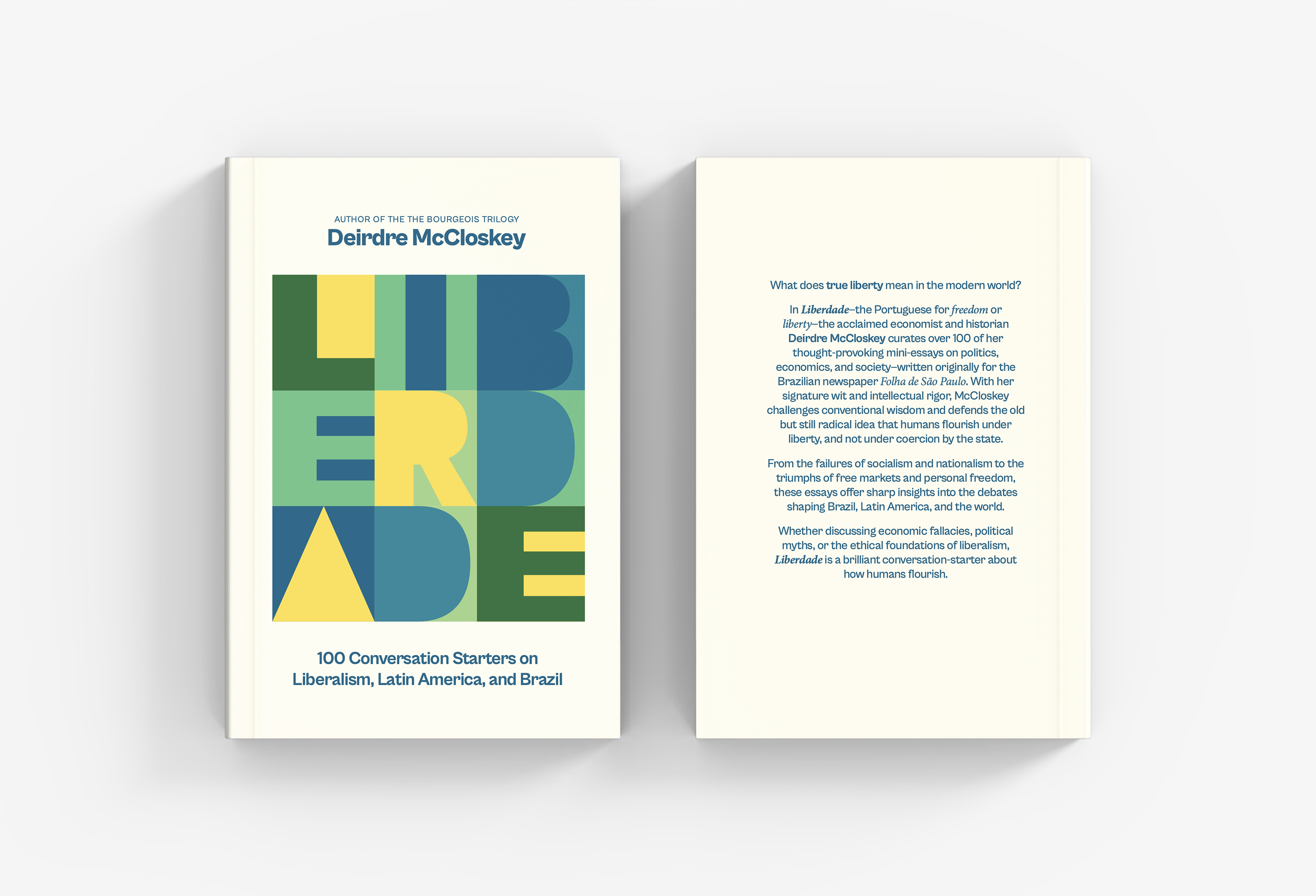
Check out my new book, Liberdade: 100 Conversation Starters on Liberalism, Latin America, and Brazil
I think "ameinocracy" sounds nicer than "kaluterocracy" and is probably a more accurate translation for "betterment".
That was fun! You’re the kind of writer I would like to have a drink with. Very interesting bio! Cheers!