

Robert Reich argues that the problem must be measured by inequality, Gini-coefficient style, not by the absolute condition of the poor. “Widening inequality,” he declares, “challenges the nation’s core ideal of equal opportunity”:
Widening inequality still hampers upward mobility. That’s simply because the ladder is far longer now. The distance between its bottom and top rungs, and between every rung along the way, is far greater. Anyone ascending it at the same speed as before will necessarily make less progress upward.1
Reich is mistaken. Horwitz summarizes the results of a study by Julia Isaacs on individual mobility 1969–2005: “82% of children of the bottom 20% in 1969 had [real] incomes in 2000 that were higher than what their parents had in 1969. The median [real] income of those children of the poor of 1969 was double that of their parents.”2 There is no doubt that the children and grandchildren of the English coal miners of 1937, whom Orwell describes “traveling” underground, bent over double walking a mile or more to get to the coal face, at which point they started to get paid, are much better off than their fathers or grandfathers. There is no doubt that the children and granchildren of the Dust Bowl refugees in California are. Steinbeck chronicled in The Grapes of Wrath their worst and terrible times. A few years later many of the Okies got jobs in the war industries, and many of their children went to university. Some became university professors who think that the poor are getting poorer.
The usual way of talking about poverty relies on the percentage distribution of income, staring fixedly for example at an official-sounding but relative “poverty line.” As the progressive Australian economist Peter Saunders observes, however, such a definition of poverty “automatically shift upwards whenever the real incomes [and hence the poverty line] are rising.”3 The poor are always with us, but merely by definition, the opposite of the Lake Wobegon effect—it’s not that all the children are above average, but that there is a bottom fifth or tenth or whatever, always, in any distribution whatsoever. Of course.
It’s not higher math. The philosopher Harry Frankfurt noted long ago that “calculating the size of an equal share [of income in the style of poverty lines or Gini coefficients] is plainly much easier than determining how much a person needs in order to have enough”—”much easier,” as in dividing GDP by population and reporting with irritation that some people earn, or get, more.4 It is the simplified ethics of the schoolyard, or dividing a cake among friends: “That’s unfair.”
But as Frankfurt also noted, inequality is in itself ethically irrelevant: “Economic equality is not, as such, of particular moral importance.” In ethical truth we wish to raise up the poor to “enough” for them to function in a democratic society and to have full human lives. It doesn’t matter ethically whether the poor have the same number of diamond bracelets and Porsche automobiles as do owners of hedge funds. It does, however, matter ethically whether they have the same opportunities to vote or to learn to read or to have a roof over their heads. The Illinois state consitution of 1970 embodied the confusion between the condition of the working class and the gap between rich and poor, claiming in its preamble that it seeks to “eliminate poverty and inequality.”5 We had better focus directly on what we actually want to achieve, which is equal sustenance and dignity, eliminating poverty, acquiring for all people what the economist Amartya Sen and the philosopher Martha Nussbaum call capabilities.6 The size of the Gini coefficient or the share of the bottom 10 percent is irrelevant to the noble and ethically relevant and actually attainable purpose of raising the poor to a condition of dignity, Frankfurt’s “enough.”
The Liberal Lady Glencora Palliser (née M’Cluskie) in Anthony Trollope’s political novel Phineas Finn (1867–1868) declares, “Making men and women all equal. That I take to be the gist of our political theory,” as against the Conservative delight in rank and privilege. But one of the novel’s radicals in the Cobden-Bright-Mill mold (“Joshua Monk”) sees the ethical point more clearly, and replies to her: “Equality is an ugly word, and frightens,” as indeed it had long frightened the political class in Britain, traumatized by wild French declarations for égalité, and by the example of American egalitarianism (well . . . egalitarianism for male, straight, white, Anglo, middle-aged, high-income, nonimmigrant, New England mainline Protestants). The motive of the true Liberal, Monk continues, should not be equality but “the wish of every honest [that is, honorable] man . . . to assist in lifting up those below him.”7 Such an ethical goal was to be achieved, Monk the libertarian liberal would argue, not by direct programs of redistribution, nor by regulation, nor by trade unions, but by free trade and rights for women and tax-financed education—and in the event above all by the Great Enrichment, which finally in the late nineteenth century started sending real wages sharply up, Europe-wide. The absolute condition of the poor has been raised overwhelmingly more by the Great Enrichment than by regulation or redistribution. As the economic historians Ian Gazeley and Andrew Newell concluded in their 2010 study of “the reduction, almost to elimination, of absolute poverty among working households in Britain between 1904 and 1937”: “The elimination of grinding poverty among working families was almost complete by the late thirties, well before the Welfare State.” Their chart 2 exhibits weekly income distributions in 1886 prices at 1886, 1906, 1938, and 1960, showing the disappearance of the inflation-adjusted classic line of misery for British workers, “’round about a pound a week.”8
Yet the left works overtime, out of the best of motives, to rescue its ethically irrelevant focus on Gini coefficients and the relative poverty line. A recent example of the leftish labor is the book by a French economist I have mentioned, Thomas Piketty’s Capital in the Twenty-First Century (translated 2014), which was greeted with squeals of delight by the American and British left, and rapidly rose to number one on the New York Times best-seller list. Piketty claims that relative poverty is what matters, whether or not the poorest improve. “Just as we’ve been saying!” the left cried. “Eliminate poverty and inequality.”
Much of the research on the economics of inequality stumbles on this simple ethical point, focusing on measures of relative inequality such as the Gini coefficient rather than on measures of the absolute welfare of the poor, on inequality rather than poverty, having elided the two. Speaking of the legal philosopher Ronald Dworkin’s egalitarianism, Frankfurt observed that Dworkin in fact, and ethically, “cares principally about the [absolute] value of people’s lives, but he mistakenly represents himself as caring principally about the relative magnitudes of their economic assets.”9 Dworkin and the left commonly miss the ethical point, which is the liberal, Joshua Monk one of lifting up the poor. By redistribution? By equality in diamond bracelets? By codes for buildings or unions for trades? No: by the dramatic increase in the size of the pie, which has historically brought the poor to 90 or 95 percent of “enough,” as against the small percent of enough attainable by redistribution without enlarging the pie. The economic historian Robert Margo noted in 1993 that before the Civil Rights Act “blacks could not aspire to high-paying white collar jobs” because of discrimination. Yet African Americans had prepared themselves, by their own efforts, up from slavery, to perform in such jobs if given a chance. “Middle-class blacks owe their success in large part to themselves,” and to the increasingly educated and productive society they lived in. “What if the black labor force, poised on the eve of the Civil Rights Movement, was just as illiterate, impoverished, rural, and Southern as when Lincoln freed the slaves? . . . Would we have as large a black middle class as we do today? Plainly not.”10
Piketty is alarmed by what he claims is the force of interest on inherited wealth causing inequality to increase. In 2014 he declared to the BBC’s Evan Davis in an interview that “money tends to reproduce itself.” Yet his own data suggest that only in the United States and the United Kingdom (with Canada) has inequality of wealth increased recently—a puzzle if money tends to reproduce itself, always, as a general law governed by his Ricardo-plus-Marx inequality-producing accumulation of financial capital, Piketty’s master algebra of r > g. Inequality in fact goes up and down in great waves, 1800 to the present, which also doesn’t figure in such a tale. Once a Piketty-wave starts it would, according to his logic, never stop, which means we should have been overwhelmed by an inequality-tsunami in 1800 CE or 1000 CE or for that matter 2000 BCE.
Nor does Piketty acknowledge entrepreneurial profit, the trade-tested betterment that through the Bourgeois Deal has made the poor rich. He focuses on the evil of rich people having seven Rolex watches by mere inheritance. Liliane Bettencourt, heiress to the L’Oréal fortune, in 2014 the wealthiest woman in the world, who “has never worked a day in her life, saw her fortune grow exactly as fast as that of [the admittedly bettering] Bill Gates.” Ugh. Which is the sum of Piketty’s ethical analysis.
The Australian economists Geoffrey Brennan, Gordon Menzies, and Michael Munger make a similar argument in a recent paper, written in advance of Piketty’s book, that inheritance inter vivos of human capital is bound to exacerbate Gini-coefficient inequality because “for the first time in human history richer parents are having fewer children. . . . Even if the increased opulence continues, it will be concentrated in fewer and fewer hands.”11 The rich will send their one boy, intensively tutored in French and mathematics, to Sydney Grammar School and on to Harvard. The poor will dissipate what little they have among their supposedly numerous children.
Yet if on account of Adam Smith’s hoped-for “universal opulence which extends itself to the lowest ranks of the people” all have access to excellent education—which is a proper subject for social policy—and if the poor are so rich (because the Great Enrichment) that they too have fewer children, which is the case, then the tendency to rising variance will be attenuated.12 The economist Tyler Cowen reminds me, further, that “low” birth rates also include zero children, which would make lines die out—as indeed they often did, even in royal families, well nourished. Nonexistent children, such as those of Grand Duke of Florence Gian Gastone de’ Medici in 1737, can’t inherit either financial or human capital.
And the effect of inherited wealth on children is commonly to remove their ambition, as one can witness daily on Rodeo Drive, or in Bettencourt’s daughter. Laziness from being rich too early is a powerful equalizer. Imagine if you had inherited ten million dollars at age eighteen, before your character was fully formed. It would have been an ethical disaster, as it regularly is for the children of the rich. However many diamond bracelets they have, most rich children don’t bother to suffer through, say, a PhD in economics. Why bother? David Rockefeller did, to be sure (University of Chicago, 1940), but his grandfather was unusually lucky in transmitting a poor boy’s values and a life-long philanthropist’s tastes to his son and then to his six John-Junior-begotten grandchildren. We prosperous parents of the Great Enrichment can properly worry about our children’s and especially our grandchildren’s incentives to undertake such efforts as a PhD, or serious entrepreneurship, or for that matter serious charity (Bettencourt’s charitable foundation, by contrast with the Rockefellers’, is comically niggardly, endowed with only one-half of 1 percent of her wealth).
And it is commonly the case, contrary to the focus of Piketty and of Brennan, Menzies, and Munger on inheritance, that the people with more money got their more by being more productive, for the benefit of us all—getting that PhD, for example, or being excellent makers of automobiles or excellent writers of novels or excellent throwers of touchdown passes or excellent providers of cell phones, such as Carlos Slim of Mexico (with a little boost, it may be, from corrupting the Mexican parliament). That Frank Sinatra became richer than most of his fans was not an ethical scandal. The “Wilt Chamberlain” example devised by the philosopher Robert Nozick says that if we pay voluntarily to get the benefit of clever CEOs or gifted athletes there is no further ethical issue.13 The unusually high rewards to the Frank Sinatras and Jamie Dimons and Wilt Chamberlains come from the much wider trading during the age of globalization and of mechanical reproduction, not from theft.14
For the poor in the countries that have allowed the ethical change to happen, Frankfurt’s “enough” has largely come to pass. “Largely,” I say, and much more than alternative systems have allowed. I do not say “completely” or “as much as every honest person would wish.” But I have noted that the contrast between the condition of the working class in the United States and in such avowedly social-democratic countries as the Netherlands or Sweden is not in fact large, despite what you have heard from journalists and politicians who have not seriously looked into the actual statistics or have not seriously experienced more than one country. The social safety net is, in practice, rather similar among rich countries. But in any event the safety net, with or without holes, is not the main lifter of the poor in the United States, the Netherlands, Switzerland, Japan, Sweden, or the others. The way to the lift is the Great Enrichment.
Boudreaux noted that a literal billionaire who participated in a seminar of his didn’t look much different from an “impoverished” graduate student giving a paper about Gini coefficients. “In many of the basic elements of life, nearly every American is as well off as Mr. Bucks [his pseudonym for the billionaire]. If wealth differences between billionaires and ordinary Americans are barely visible in the most routine aspects of daily life, then to suffer distress over a Gini coefficient is to unwisely elevate ethereal abstraction over palpable reality.”15 Mr. Bucks undoubtedly had more houses and more Rolls Royces than the graduate student. One may ask, though, the cheeky but always relevant question: So what?
People are actually and ethically looking for a standard of what is enough for a dignified life in a given society. How much dough is enough? To the Dust Bowl refugees the minstrel Woody Guthrie sang, “California’s a garden of Eden, / A paradise to live in or see. / But believe it or not / You won’t find it so hot / If you ain’t got the do re mi.” You need the dough in the do re mi to buy the roof and the toilet and the food at California prices. Therefore Peter Saunders and others such as Horwitz and the theorists of capabilities propose to look at the goods poor people can buy and the rights they have. They ask: What’s enough? Saunders determined “the items that are widely regarded as essential in today’s [Australian] society,” such as a telephone, a washing machine [thus the Washing Line], a separate bed for each child.16 The “widely regarded” in his study comes from an opinion poll of Australians. If things go well by such a measure the level of Australian poverty can possibly fall. With an ever-rising relative poverty line it can never fall, which is nice for pessimists but silly as science or policy. If one uses a Gini coefficient, the measure of inequality becomes the level of diamond-encrusted-watch owning, excesses that are annoying and blameworthy but ethically irrelevant so far as state compulsion is concerned. After all, many private actions are blameworthy without triggering justifiable interference by the state—listening to NPR without pledging, or failing once again to go to the gym, or not eating your vegetables. Measuring rather the goods poor people can buy and the rights they have, public policy (that is, state compulsion) can focus on what actually matters to dignity, such as making schools work well, improving medical care, ending the War on Drugs, preventing voter suppression, changing the trade union–determined building code so that apartments can be built that the poor can occupy in a dignified way at a low rent.
Using Saunders’s survey, for example, between 2006 and 2010 (which includes the world’s Great Recession years, though at the time Australia was having a mining boom selling to China), the average number of items, out of the twenty-four the Australian public viewed as “essential,” that were absent in single-parent households fell from 3.6 to 2.9. If things had got worse, with the number of absent essentials rising to 6.9 instead of falling to 2.9, Australians would have a justifiable basis for alarm, and some indication of what to do about it.
The postmodern French philosopher worshipped on the left, Michel Foucault (1926–1984), provides unlikely support for such thinking. Daniel Zamora, a Belgian sociologist, in an interview about his 2014 book Critiquer Foucault (Criticizing Foucault) reports that
Foucault himself met with [the conservative French economist Lionel] Stoléru several times when Stoléru was a technical advisor on the staff of [the right-wing French president] Valéry Giscard D’Estaing. An important argument runs through [Stoléru’s] work and directly attracted Foucault’s attention: in the spirit of [Milton] Friedman, it draws a distinction between a policy that seeks equality (socialism) and a policy that simply aims to eliminate poverty without challenging disparities (liberalism). . . . [Stoléru wrote:] “I believe the distinction between absolute poverty and relative poverty is in fact the distinction between capitalism and socialism.”
Indeed. Solving absolute poverty came in fact from the Great Enrichment, and attempting to solve a logically insoluble relative poverty resulted in slow growth and the encouragement of an insatiable envy.
The result is general. Despite the clamor about poverty lines and Gini coefficients, nowhere in the past few decades except in war-of-all-against-all countries such as Somalia have conditions measured by a correct standard of “enough” worsened, even in notably unequal places such as Brazil, South Africa, Chile, China, or the United States. They have got better.
The text above is an excerpt from Bourgeois Equality: How Ideas, Not Capital or Institutions, Enriched the World, the third volume of Deirdre McCloskey’s trilogy on the ethical and historical origins of modern prosperity.
Notes
Reich 2014.
Isaacs 2007, quoted in Horwitz 2013, p. 7.
Saunders 2013, p. 214.
Frankfurt 1987, pp. 23–24.
ilga.gov/commission/lrb/conent.htm.
Sen 1985; Nussbaum and Sen 1993.
Trollope 1867–1868, vol. 1, pp. 126, 128.
Gazeley and Newell 2010, abstract, p. 19, chart 2 (p. 17).
Frankfurt 1987, p. 34; my italics.
Margo 1993, pp. 68, 65, 69.
Brennan, Menzies, and Munger 2013.
Smith 1776, 1.1.10, p. 22.
Nozick 1974, p. 164.
Benjamin 1936.
Boudreaux 2001.
Saunders 2013, pp. 213, 215.
Since 1776, there has been a 3,000% explosion in the average real income per person in the world.
Nothing earlier came remotely close.
It was caused not by the usual suspects of investment or exploitation, but by liberty inspiring a flowering of human creativity—in the arts and sciences, and in the economy.
Though Brazilians and many other Latin Americans are uneasily aware that their economies lag some, and sometimes a lot, the Great Enrichment is nonetheless evident everywhere from the Border to Tierra del Fuego, from Santiago in Chile to Recife in Brazil.
The Latin Lag can be overcome. Brazil, like much of Latin America, needs essential liberalism to do it.
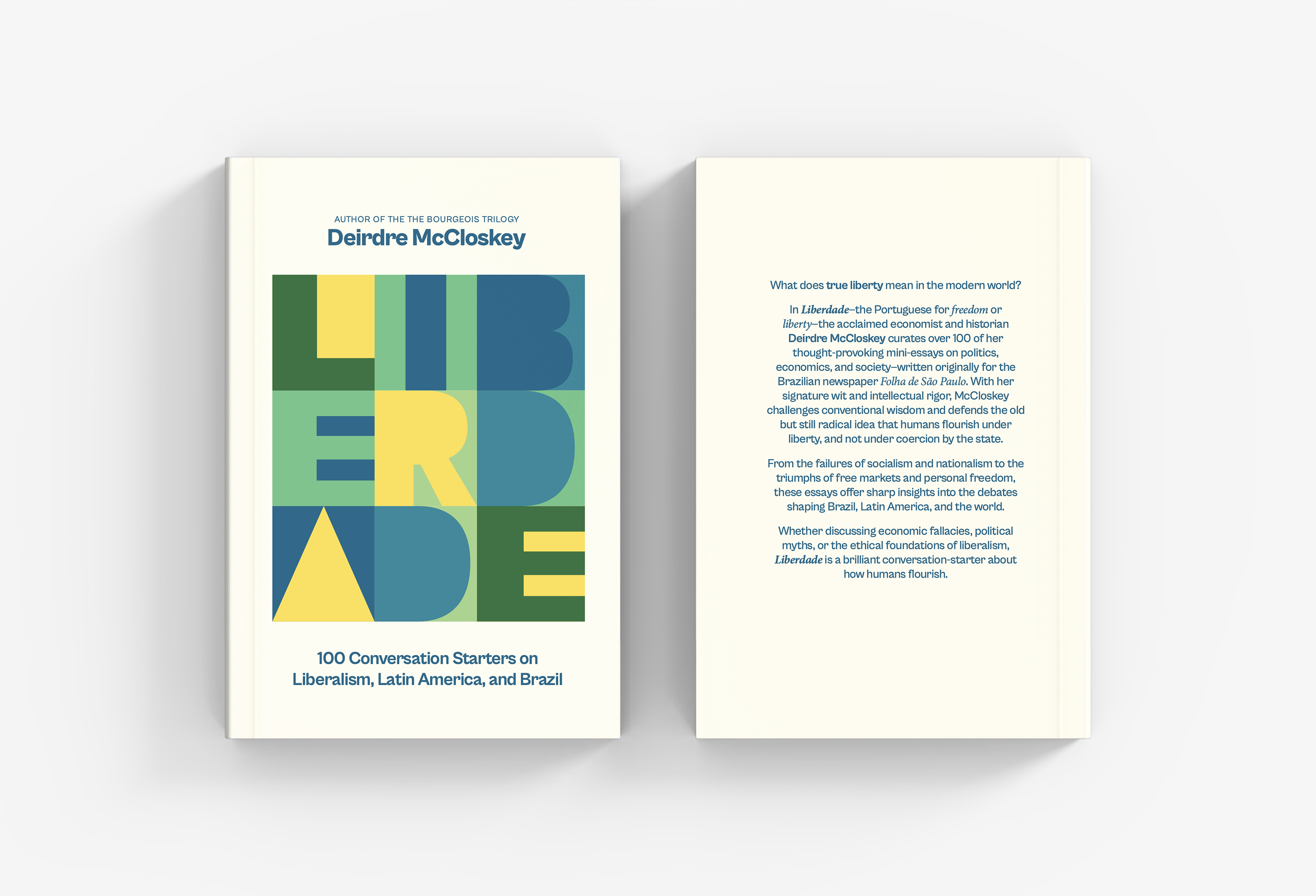
Check out my new book, Liberdade: 100 Conversation Starters on Liberalism, Latin America, and Brazil
For me, a staggeringly important yet so often entirely missed concept. As with so many close to perfect ideas it is blindingly obvious once seem. Embarrassingly so yet, to mangle Churchill, we blunder on unseeing.
Your work here enlightens- critically. Thank you.
On the one had, I give the core idea here 10 stars. The idea cannot be emphasized enough, and McCloskey does it very well here.
It is close to the single most important idea that ordinary and so-called smart people alike get wrong.
On the other hand “Yet the left works overtime, out of the best of motives…” is beyond merely being charitable or even “too charitable” to the left.
Because while I don’t doubt there are a fair number of leftist midwits who have only the best motives on this point, the politicians and economists and serious influencers decidedly do *not* promote this politics of envy idea out of good motives.
They do it as a means of leftists attaining and executing authoritarian political power.