


José and Marie are 3-year-old twins. Marie is playing with a doll, which José would like to take and throw repeatedly across the room. Just for the hell of it. He says, “Gimme!” Marie says, “No!” He turns to Mommy and says, “Mommy, make Marie give it to me!” Mommy says, “No, José. That’s Marie’s doll.” José is about to simply grab the doll, but another way occurs to him: “Marie, I’ll give you my truck to play with if you give me your doll to play with.” Marie agrees, and the play goes on peacefully.
That is to say, one citizen stealing from another is bad. Appealing to the state to steal from one citizen to give to another is also bad. What’s good? Voluntary exchange.
Every Wednesday from 12:00 to 12:30 the U.K. Prime Minister has to answer questions from other members of Parliament. If he dodges a question, the members shout or laugh derisively. It’s glorious, from the place, with all its loony British traditions, that gave us our liberties.
Sometimes the questions are grave deliberations on policy for the nation, such as whether the U.K. should join the USA in bombing Iran. But when I was listening last night, it struck me that the great bulk of the questions are like José appealing to Mommy to take from Marie and give to him. The member of Parliament from Durnford will ask—always addressing the Speaker of the House to avoid direct insults and confrontations—“Mr. Speaker, will the Prime Minister order his Minister of Transport to give Durnford a new highway?” or “Mr. Speaker, will the Prime Minister arrange tariff protection to prevent U.K. people from buying from foreigners what we make in Durnford?” To get the money for the new road, someone needs to be coerced to pay the taxes. To get the protection against competition, someone needs to be coerced not to buy abroad.
Now, of course, the appeals to the coercive powers of His Majesty’s Government arise from democracy. The members of Parliament are elected, and want to keep their jobs. The voters, like 3-year-olds, expect their elected member to get them favors from the Government. Marie’s doll.
On November 3, 1774, the great quasi-liberal conservative member of Parliament, Edmund Burke, delivered his immortal “Speech to the Electors of Bristol.” He was responding to a claim by his opponent in an election that a representative ought to be, as the members at Question Time themselves show themselves mainly to be, mere servants of the self-interested opinions of their voters. Burke declared, “Your representative owes you, not his industry only, but his judgment; and he betrays, instead of serving you, if he sacrifices it to your opinion. . . . Parliament is a deliberative assembly of one nation, with one interest, that of the whole; where not local purposes, not local prejudices, ought to guide, but the general good, resulting from the general reason of the whole.”
How can we reconcile democracy with liberalism? Grow up. Become ethical adults, not 3-year-olds. Stop expecting everything from the state. Stop appealing to Mommy for anything but justice as she sees it. Not Marie’s doll.
Weekly column in Folha de São Paulo, Brazil
Translated into Portuguese for the newspaper.
Since 1776, there has been a 3,000% explosion in the average real income per person in the world.
Nothing earlier came remotely close.
It was caused not by the usual suspects of investment or exploitation, but by liberty inspiring a flowering of human creativity—in the arts and sciences, and in the economy.
Though Brazilians and many other Latin Americans are uneasily aware that their economies lag some, and sometimes a lot, the Great Enrichment is nonetheless evident everywhere from the Border to Tierra del Fuego, from Santiago in Chile to Recife in Brazil.
The Latin Lag can be overcome. Brazil, like much of Latin America, needs essential liberalism to do it.
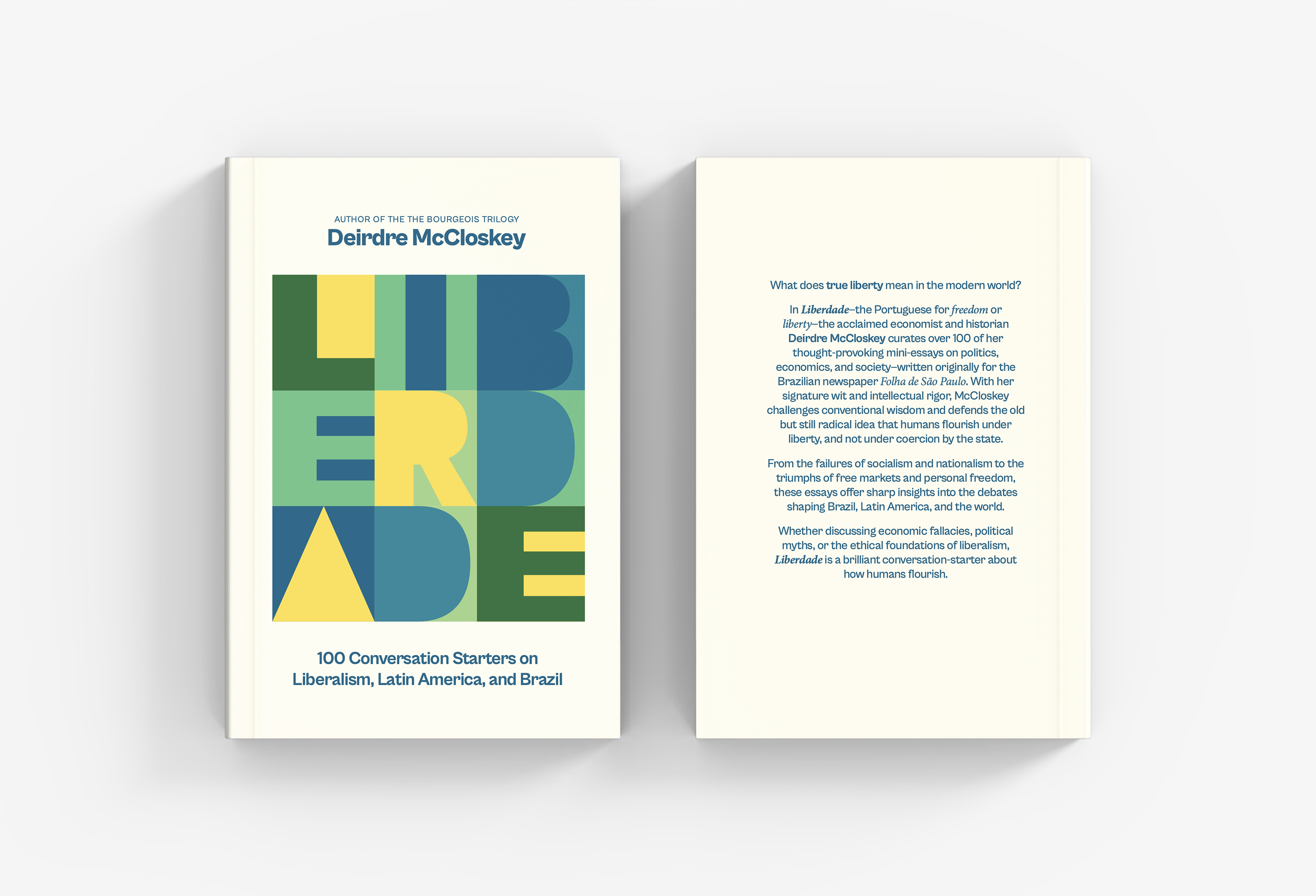
Check out my new book, Liberdade: 100 Conversation Starters on Liberalism, Latin America, and Brazil
👍🏻
Nice! Clear, well-said.